

Offshore Wind Energy Market Projected to Reach USD 189.7 Billion by 2035, Growing at 11.8% CAGR
Offshore Wind Energy Market
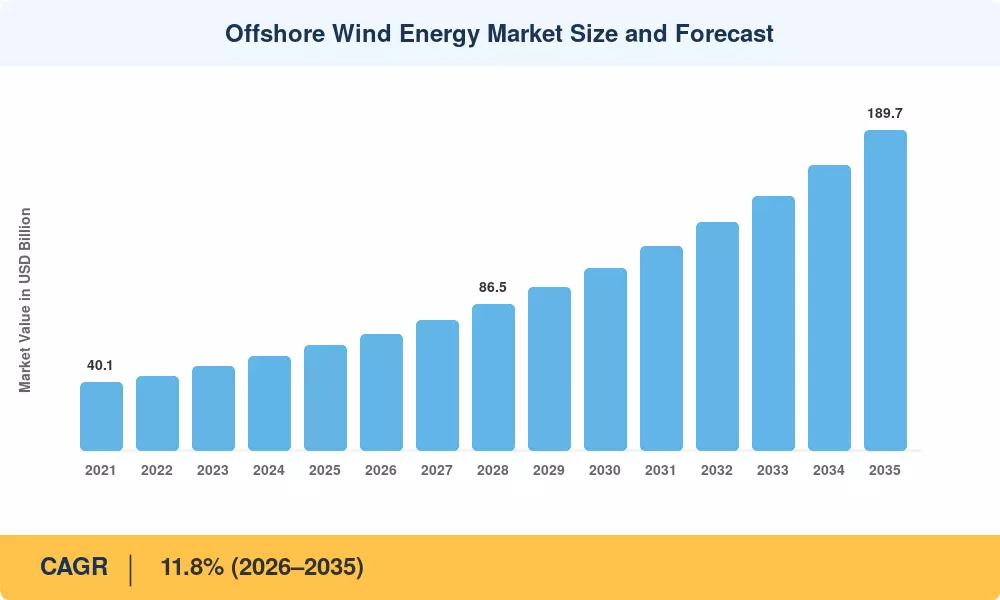
Offshore Wind Energy Market is projected to reach USD 189.7 Billion, at a 11.8% CAGR by 2035.
As Per the MRFR Analysis, Offshore Wind Energy Market is projected to reach USD 189.7 Billion, at a 11.8% CAGR by driving industry size, share, top company Analysis, trends and forecast report to 2035”
NEW YORK, NY, UNITED STATES, August 24, 2026 /EINPresswire.com/ -- As Per the MRFR Analysis, Offshore Wind Energy Market is projected to reach USD 189.7 Billion, at a 11.8% CAGR by driving industry size, share, top company Analysis, segments research, trends and forecast report to 2035.— Prashant Hake
Market Overview
The Offshore Wind Energy Market encompasses the development, construction, operation, and maintenance of wind farms situated in marine environments, including turbines, substructures, electrical infrastructure, installation services, and long-term operations. This renewable energy segment has emerged as a critical component of global decarbonization strategies, offering high-capacity-factor generation with the scale necessary to meet ambitious climate targets.
Two catalysts anchor that trajectory. The European Union's REPowerEU framework locked in a 2030 target exceeding 110 GW of installed offshore capacity, while the U.S. Inflation Reduction Act extended investment tax credits worth up to 30% of qualifying project capital cost through 2032 [1][3]. Neither is aspirational language; both translate directly into signed power purchase agreements and steel in the water. The Offshore Wind Energy Market therefore behaves less like a speculative clean-tech segment and more like regulated infrastructure with a visible order book. Global investment in offshore wind reached approximately USD 78 billion in 2024, with floating platforms absorbing a rising share of engineering spend [5][9].
A fundamental technology transition is reshaping the Offshore Wind Energy Market. Turbine platforms have changed underneath the industry. Fixed-bottom monopiles carrying 6–8 MW machines — the workhorse of 2015–2020 — are giving way to 15–18 MW direct-drive units and, increasingly, semi-submersible floating substructures capable of operating in water beyond 60 metres [5][9]. This generational leap in turbine capacity significantly reduces levelized cost of energy (LCOE), with IRENA reporting that global weighted-average LCOE for offshore wind fell 34% between 2010 and 2023, and further reductions are expected as larger turbines and floating technologies achieve commercial scale.
Policy and regulatory influence continues to shape the Offshore Wind Energy Market. Governments are now issuing contracts instead of targets. The UK's Contracts for Difference Allocation Round de-risks over GBP 20 billion of committed capital over recent rounds by guaranteeing strike prices linked to inflation over 15-year terms [3]. Japan's Sea Area Utilization Act grants 30-year occupancy rights at auctions, making project financing bankable at commercial spreads [13]. The U.S. Bureau of Ocean Energy Management (BOEM) completed the Central Atlantic lease auction in February 2024, expanding federally leased acreage available for future solicitations [6].
The demand outlook for the Offshore Wind Energy Market remains exceptionally strong. Europe still commands 46.5% of global value, built on three decades of North Sea learning curves. Asia-Pacific grows fastest at 13.6% annually as China, Taiwan, Japan and South Korea convert auction pipelines into construction. North America ranks third, propelled by state-level procurement mandates in New York, New Jersey and Massachusetts. The market is projected to reach USD 108.1 billion by 2030 and USD 189.7 billion by 2035, driven by policy mandates, corporate offtake, and grid investment that removes binding constraints on project development [1][3][8].
📍 Get Free Sample Report for Detailed Market Insights:
https://www.marketresearchfuture.com/sample_request/28730
Market Segmentation
By Foundation Technology
The Offshore Wind Energy Market splits most fundamentally along water depth economics. Fixed-bottom foundations retain 84.2% of market value in 2025, reflecting mature supply chains and bankable EPC contracts [9]. Monopile foundations dominate with 58.5% share, serving shallow North Sea and Chinese coastal sites where they are simple, fast to install, and supported by a manufacturing base capable of rolling 10-metre-diameter sections. Their limitation is depth: beyond roughly 45 metres, steel tonnage rises faster than energy yield. Jacket foundations fill the intermediate band with 18.4% share and are gaining share as 18 MW turbines impose loads that monopiles struggle to carry economically [7].
Floating substructures (semi-submersible, tension-leg, and spar designs) post the steepest expansion at 24.5% CAGR through 2035 as deep-water leases open off California, Scotland and Japan [9]. Roughly 80% of global offshore wind resource sits in water deeper than 60 metres, beyond fixed-bottom economics. Floating platforms therefore unlock the entire U.S. West Coast, most of Japan, and the Mediterranean, representing a transformative opportunity for the Offshore Wind Energy Market.
By Component
The Offshore Wind Energy Market is segmented into Turbines, Substructures & Foundations, Electrical Infrastructure, Installation & Logistics, and Operations & Maintenance. Turbines command the largest single share at 44.0% of market value, driven by capacity scaling and OEM order backlogs [5]. Substructures and foundations account for USD 14.9 billion in 2025, driven by steel fabrication and depth requirements. Electrical infrastructure is the fastest-growing component at a 12.5% CAGR, driven by HVDC export and interconnection buildout [8]. Installation and logistics represent 15.0% share, reflecting vessel charter and port staging costs. Operations and maintenance is expanding at a 13.8% CAGR, representing a structural shift that makes revenue less cyclical than the construction pipeline alone would suggest.
By End User
The Offshore Wind Energy Market serves Utilities & Independent Power Producers (IPPs), Industrial & Corporate Offtakers, and Government & State Entities. Utilities and IPPs account for 71.5% of installed project ownership, driven by regulated offtake and balance sheet capacity [12]. Corporate PPA-backed capacity within the market grows at 16.2% CAGR as data centre operators contract directly for offshore wind's high capacity factor—typically 45–55% compared to about 25% for onshore solar—making it exceptionally appealing for facilities needing reliable 24-hour supply [12]. Government and state entities contribute USD 6.8 billion in 2025 through national energy security programmes.
By Region
Europe holds a 46.5% share, anchored by the United Kingdom, Germany, and the Netherlands. Asia-Pacific expands at 13.6% CAGR, the fastest of any region, driven by auction rollout and domestic supply chain development. North America contributes roughly USD 8.1 billion in 2025 revenue, propelled by state procurement and port upgrades. South America and the Middle East & Africa represent smaller but emerging markets, with Brazil's 2025 offshore regulatory framework and Morocco's European export interconnection studies signalling future growth [13].
🛒 You can buy this market report at:
https://www.marketresearchfuture.com/checkout?currency=one_user-USD&report_id=28730
Regional Analysis
Europe
Europe commands 46.5% of the Offshore Wind Energy Market, built on three decades of North Sea operations that produced standardised consenting, mature O&M ports and a service vessel fleet that no other region matches. The United Kingdom leads with 31.5% of regional share, driven by Contracts for Difference allocation rounds that guarantee strike prices linked to inflation [3]. Germany follows with 22.0% share, targeting 70 GW by 2045 through statutory mandates. The Netherlands contributes 15.5% through tender-based zero-subsidy awards, while Denmark's 9.0% share is driven by energy island development [1]. Poland's Baltic programme and France's Atlantic tenders now extend that base geographically, representing the most significant near-term capacity additions in Eastern and Southern Europe [4].
Asia-Pacific
Asia-Pacific is the fastest-growing region in the Offshore Wind Energy Market, expanding at 13.6% CAGR as auction pipelines convert to construction. China alone commissions more offshore capacity annually than the rest of the world combined, with provincial capacity allocation driving 2025 value of USD 17.2 billion, supported by a vertically integrated domestic supply chain that has driven turbine prices well below Western benchmarks [7]. Taiwan follows with USD 2.4 billion through Round 3 grid connection awards, pioneering localisation mandates that seeded an Asian component base. Japan's Sea Area Utilisation Act auctions generated USD 1.9 billion in 2025, with typhoon and seismic conditions demanding engineering variants unavailable in European catalogues [13]. South Korea and the Rest of Asia-Pacific (including Vietnam and India) contribute through Renewable Portfolio Standard obligations and early-stage pipelines respectively [1].
North America
North America contributes roughly USD 8.1 billion to the Offshore Wind Energy Market, growing from a small base and depending heavily on state-level procurement holding firm through federal policy shifts. The United States leads with a 15.4% CAGR through 2035, driven by state offtake solicitations and tax credits under the Inflation Reduction Act [1]. New York, New Jersey, Massachusetts, and Maryland have collectively contracted several gigawatts, and port investments at New Bedford and Portsmouth create the staging capacity that earlier rounds lacked [3][6]. Canada's Nova Scotia licensing framework targets 5 GW of offering by 2030, while Mexico proceeds with early feasibility assessment [6].
Rest of the World
South America and the Middle East & Africa represent smaller but emerging segments of the Offshore Wind Energy Market. Brazil dominates South American demand with 78% of regional share, driven by the 2025 offshore regulatory framework that resolved the tenure question that had frozen dozens of environmental applications [13]. Hydrogen export ambitions to Europe give several proposed projects a second revenue thesis beyond domestic power sales. Morocco leads the MEA region with a 17.5% CAGR through 2035, driven by European export interconnection studies, while South Africa and the Rest of MEA evaluate offshore capacity primarily for desalination power coupling and coastal resource mapping [13].
Competitive Landscape / Key Players
The Offshore Wind Energy Market exhibits high concentration at the turbine layer and moderate concentration at the development layer. The top five turbine OEMs hold roughly 80% of installed nameplate capacity, while the top five developers control an estimated 40–45% of operating capacity [14]. Key players include Siemens Gamesa Renewable Energy, Vestas Wind Systems, Ørsted, Mingyang Smart Energy, GE Vernova, RWE, Iberdrola, Goldwind, Prysmian Group, and Van Oord [14].
Siemens Gamesa Renewable Energy leads with an estimated 13–17% revenue share, offering direct-drive turbines and service agreements as the Western turbine share leader [5]. Vestas Wind Systems follows with 10–14% share, focusing on its V236 platform and long-term service with scale and reliability focus. Ørsted holds 8–12% share as the largest pure-play developer, offering project development, ownership, and O&M services [10]. Mingyang Smart Energy commands 7–10% share, specializing in large-rotor and floating turbines with cost-led Asian expansion. GE Vernova holds 5–8% share, offering the Haliade-X platform and grid equipment with a turbines-plus-transmission strategy. RWE and Iberdrola maintain diversified utility developer positions with 5–8% and 4–7% shares respectively [14].
Strategic developments in the industry include the European Commission's March 2023 adoption of the Net-Zero Industry Act proposal setting domestic manufacturing benchmarks, giving European component suppliers a policy shield against import competition [1]. Ørsted announced discontinuation of two U.S. East Coast projects with impairments exceeding USD 4 billion in November 2023, resetting industry expectations on fixed-price offtake risk [10]. Vestas confirmed serial production readiness for its 15 MW-class offshore platform in May 2024, shortening delivery lead times for European projects [5]. The UK Government raised administrative strike prices in its allocation round in September 2025 after a prior undersubscribed auction, restoring developer bid participation [3].
Latest Industry News & Developments
European Commission (March 2023): Adopted the Net-Zero Industry Act proposal setting domestic manufacturing benchmarks, giving European component suppliers a policy shield against import competition [1].
Ørsted (November 2023): Announced discontinuation of two U.S. East Coast projects with impairments exceeding USD 4 billion, resetting industry expectations on fixed-price offtake risk [10].
U.S. Bureau of Ocean Energy Management (February 2024): Completed Central Atlantic lease auction, expanding federally leased acreage available for future solicitations [6].
Vestas (May 2024): Confirmed serial production readiness for its 15 MW-class offshore platform, shortening delivery lead times for European projects [5].
Japan METI (December 2024): Awarded Round 3 sea area occupancy rights, extending the national pipeline toward the 10 GW-by-2030 objective [13].
UK Government (September 2025): Raised administrative strike prices in its allocation round after a prior undersubscribed auction, restoring developer bid participation [3].
Market Challenges & Opportunities
Challenges
The Offshore Wind Energy Market faces several notable challenges. Installation vessel scarcity represents a significant physical constraint, with fewer than 15 vessels globally capable of installing 15 MW-class turbines at current hub heights, while newbuild wind turbine installation vessels have lead times of three years and cost between USD 350 and USD 500 million [11]. Charter rates for capable units nearly doubled between 2022 and 2025, and projects without reserved slots face higher financing costs.
Interest rate and capex inflation have disrupted legacy bid assumptions, with fixed-price offtake agreements clashing with double-digit capex inflation and higher benchmark rates in 2023–2024, leading several developers to write down or cancel U.S. East Coast projects [10]. Permitting and consenting delays in North America and Asia-Pacific, where federal environmental review has historically consumed four to seven years per lease area, add further uncertainty [6]. Grid connection queue congestion in Europe and North America creates project delays that cascade through interconnection schedules [8]. Supply chain concentration risk, with turbine OEMs reliant on few manufacturing hubs, compounds these challenges.
Opportunities
Significant opportunities exist in the Offshore Wind Energy Market. Floating platforms unlock deep-water coastlines, with roughly 80% of global offshore wind resource sitting in water deeper than 60 metres [9]. Commercial-scale floating arrays are expected to move from tens to thousands of megawatts during the forecast window, with early projects in Scotland, France, and California demonstrating viability.
Offshore hydrogen coupling presents a transformative opportunity, with dedicated offshore capacity feeding electrolysers to sidestep grid queues entirely [1]. Pilot projects in the Netherlands and Germany are testing in-array hydrogen production with pipeline export, converting a curtailment liability into a saleable molecule. Emerging market entry points in Vietnam, India, Brazil, and Morocco all hold strong coastal wind resources with limited installed capacity, and recent regulatory frameworks in India and Brazil establish the licensing certainty that developers require before committing survey capital [13]. Data-driven service revenue through predictive maintenance platforms and digital twins reduces unplanned downtime and creates recurring revenue streams, while repowering the first generation of North Sea arrays offers new capacity without new permitting risk [4].
To explore more market insights, visit us at:
https://www.marketresearchfuture.com/reports/offshore-wind-energy-market-28730
Final Market Summary
The Offshore Wind Energy Market is poised for exceptional growth, projected to expand from USD 68.9 billion in 2026 to USD 189.7 billion by 2035, at a CAGR of 11.8%. This expansion is fundamentally underpinned by policy mandates that convert ambition into contracted capacity, corporate offtake that reshapes the buyer base, and grid investment that removes binding constraints on project development. Europe maintains its dominant position, while Asia-Pacific emerges as the fastest-growing region, driven by auction rollouts and domestic supply chain development. Technological innovation, including 15+ MW turbines, floating platforms, and HVDC electrical infrastructure, is reshaping the competitive landscape, enabling operators to achieve lower levelized costs and access deeper-water resources. The market's long-term potential remains exceptionally strong, supported by the convergence of decarbonization policy, data centre demand, and emerging opportunities in offshore hydrogen coupling and repowering, ensuring offshore wind's critical role as a cornerstone of the global energy transition through 2035 and beyond.
More Related Reports from MRFR Library:
Low Voltage Circuit Breakers Market: https://www.marketresearchfuture.com/reports/low-voltage-circuit-breakers-market-6927
Battery Monitoring Systems Market: https://www.marketresearchfuture.com/reports/battery-monitoring-system-market-6985
Boiler Control Market: https://www.marketresearchfuture.com/reports/boiler-control-market-6988
MCB and MCCB Market: https://www.marketresearchfuture.com/reports/mcb-and-mccb-market-7260
Gas Turbine Services Market: https://www.marketresearchfuture.com/reports/gas-turbine-services-market-7271
Industrial Gearbox Market: https://www.marketresearchfuture.com/reports/industrial-gearbox-market-7272
Substation Monitoring Market: https://www.marketresearchfuture.com/reports/substation-monitoring-market-7341
Centrifugal Pump Market: https://www.marketresearchfuture.com/reports/centrifugal-pump-market-7351
Pumps Market: https://www.marketresearchfuture.com/reports/pumps-market-7423
Gear Motor Market: https://www.marketresearchfuture.com/reports/gear-motor-market-7473
Larry Wilson
WantStats Research And Media Pvt. Ltd.
+1 855-661-4441
email us here
Legal Disclaimer:
EIN Presswire provides this news content "as is" without warranty of any kind. We do not accept any responsibility or liability for the accuracy, content, images, videos, licenses, completeness, legality, or reliability of the information contained in this article. If you have any complaints or copyright issues related to this article, kindly contact the author above.
